Easy Educational Art Projects for Kids in Elementary School
Elementary classrooms are facing a creativity crisis. Budget constraints have slashed art programs, while standardized testing pressures push teachers toward rigid academic drills. Yet research consistently shows that children who engage in hands-on creative activities develop stronger cognitive abilities, better problem-solving skills, and enhanced academic performance.
Educational art projects aren’t just about making things look pretty—they’re powerful learning tools that build the neural pathways essential for reading comprehension, mathematical reasoning, and scientific thinking. When children paint, sculpt, or create collages, they’re simultaneously developing fine motor control, spatial awareness, and executive function skills that translate directly into academic success.
This comprehensive guide shares practical, budget-friendly art activities designed specifically for elementary students. You’ll discover projects using simple household materials that address developmental milestones while keeping kids genuinely engaged in the learning process.
Why Art Education Matters More Than Ever for Elementary Students
The landscape of elementary education has shifted dramatically over the past decade. Many schools have reduced or eliminated dedicated art instruction, viewing creative activities as supplementary rather than essential. This approach fundamentally misunderstands how young brains develop and learn.
Working with scissors improves fine motor control, while painting and drawing boost hand-eye coordination. These aren’t trivial skills—they’re the foundation for handwriting, typing, and countless daily tasks that require precise hand movements.
Beyond physical development, creative activities stimulate multiple brain regions simultaneously. When a child plans a drawing, selects colors, and executes their vision, they’re engaging in complex decision-making that mirrors the thinking required for essay writing or mathematical problem-solving. These same principles apply to coloring pages—as outlined in coloring pages as developmental tools on our site—where grip development, hand control, and visual coordination all grow stronger.
The Hidden Academic Benefits of Creative Activities
Children who regularly participate in art projects demonstrate measurable improvements across core academic subjects. The connection isn’t mysterious—creative work develops transferable cognitive skills that apply throughout the curriculum.
Visual-spatial reasoning developed through drawing and sculpture directly supports geometry concepts and map reading. The sequential thinking required to complete multi-step craft projects strengthens the organizational skills needed for long division or science experiments.
Pattern recognition skills honed through creating mosaics or symmetrical designs translate into reading fluency and mathematical thinking. When children identify visual patterns in their artwork, they’re building the same neural pathways used for recognizing letter combinations and number sequences.
Comprehensive Skill Development Through Creative Expression
Educational art projects simultaneously address multiple developmental domains. Understanding these connections helps parents and teachers maximize the learning value of creative activities.
Physical Skills Enhanced Through Art Activities
Hand Strength and Dexterity Manipulating art materials provides natural resistance training for small hand muscles. Squeezing glue bottles, tearing paper, and molding clay build the endurance needed for extended writing tasks.
Bilateral Coordination Many art activities require both hands working together in different roles—one hand stabilizes paper while the other cuts, or one hand holds a paintbrush while the other positions the palette. This coordination between body sides is essential for countless daily activities and academic tasks.
Visual-Motor Integration Translating mental images into physical creations requires precise coordination between what children see and how their hands respond. This skill directly impacts handwriting legibility and mathematical computation accuracy.
Cognitive and Emotional Growth
Executive Function Development Planning an art project from concept to completion exercises the same executive function skills required for managing homework assignments or completing research projects. Children learn to break complex tasks into manageable steps, monitor their progress, and adjust strategies when needed.
Problem-Solving Under Constraints Working with limited materials teaches resourcefulness and creative thinking. When children must figure out how to represent a three-dimensional object using only paper and glue, they develop the flexible thinking that supports innovation across all subject areas.
Emotional Regulation The focused attention required for detailed art work provides natural mindfulness practice. Children learn to manage frustration, persist through challenges, and experience the satisfaction of completed work—building resilience that transfers to academic challenges.
Simple Paint-Based Projects That Build Core Skills
Painting activities offer tremendous educational value while requiring minimal specialized equipment. These projects use techniques that develop specific skills while encouraging creative expression.

Dot Painting for Focus and Precision
Create detailed images using cotton swabs or pencil erasers dipped in paint. This technique demands sustained attention and controlled hand movements, directly building the finger strength needed for pencil grip.
Start with simple outline drawings—animals, flowers, or geometric shapes work well. Children dip their tool in paint and carefully fill the design with dots, learning to control paint application and develop patience for detailed work.
Salt Texture Painting for Sensory Exploration
Combine art with simple chemistry by drawing designs with white glue, sprinkling coarse salt over the wet glue, then painting the dried salt with watercolors. The salt crystals absorb paint unpredictably, creating unique color patterns that teach cause-and-effect relationships.
This project builds understanding of material properties—how different substances interact and transform. Children observe absorption, color mixing, and texture creation while developing vocabulary for describing their observations.
Symmetry Exploration Through Fold Painting
Fold construction paper in half, open it flat, and apply paint dollops to one side. Carefully fold the clean half onto the painted surface, press gently to transfer the paint, then open to reveal a symmetrical design.
This activity provides concrete, visual understanding of symmetry—a mathematical concept that can seem abstract when only taught through worksheets. Children see immediately how shapes and colors mirror across a central axis.
Marble Painting for Bilateral Coordination
Place paper in a shallow tray or box lid, add paint drops or lines, then place one or more marbles on the paper. Children tilt the tray side to side, rolling the marbles through the paint to create abstract designs.
This seemingly simple activity provides powerful bilateral coordination practice. Both hands must work together with precise timing and coordination—exactly the skills needed for activities like cutting on a curved line or playing musical instruments.
Paper-Based Projects: Maximum Learning With Minimal Cost
Paper crafts offer incredible versatility while remaining accessible to every classroom and household. These projects prove that sophisticated learning doesn’t require expensive materials.
Shape Composition for Geometric Understanding
Cut or tear various shapes from construction paper—circles, triangles, squares, rectangles—then arrange them into pictures or abstract designs. This hands-on work with geometric shapes builds fundamental mathematical concepts while encouraging compositional thinking.
Children naturally experiment with size relationships, spatial arrangements, and pattern creation. They develop vocabulary for describing shapes, positions, and relationships—language that directly supports mathematical communication.
Torn Paper Collages for Texture and Composition
Tearing paper rather than cutting develops different hand muscles while creating interesting textured edges. Children can create landscapes, animals, or abstract compositions entirely from torn paper pieces.
This technique removes the perfection pressure that cutting with scissors can create. The irregular edges add character to the work while building confidence in children who struggle with precise scissor control.
Tissue Paper Sculpture for Three-Dimensional Thinking
Crumple small tissue paper squares around a pencil eraser, dip the end in glue, then press onto paper to create textured designs. The accumulated tissue creates dimensional surface interest while building hand strength through the repetitive crumpling motion.
This project teaches color layering—how overlapping translucent materials create new colors. Children experiment with density and distribution, learning through experience how spacing affects visual impact.
Origami for Sequential Thinking
Traditional paper folding teaches precise following of multi-step instructions—exactly the skill needed for scientific procedures or mathematical algorithms. Each fold must be accurate for the final result to succeed, teaching attention to detail and the importance of sequence.
Start with simple designs requiring three to five folds, gradually progressing to more complex creations. Children develop spatial visualization skills as they learn to mentally predict how flat paper will transform into three-dimensional forms.

Manipulative-Based Activities for Tactile Learners
Some children learn most effectively through direct manipulation of three-dimensional materials. These projects engage kinesthetic learners while building essential academic skills.
Modeling Compound Creations for Storytelling
Use modeling clay, playdough, or homemade salt dough to create characters, objects, or scenes. Children can make manipulatives for math practice, create story characters for narrative writing, or build models demonstrating scientific concepts.
The resistance of modeling compounds provides excellent hand strengthening. Pinching, rolling, and molding movements build the same muscles needed for sustained handwriting and tool use.
Scratch Art for Process Understanding
Rainbow scratch paper—black coating over rainbow colors—allows children to create designs by scratching away the top layer. This reveals how artists work subtractively as well as additively, removing material to create form.
The wooden stylus used for scratching builds appropriate pencil pressure. Children learn to control force and direction, skills that directly transfer to handwriting and drawing.
Natural Material Assemblages for Observation Skills
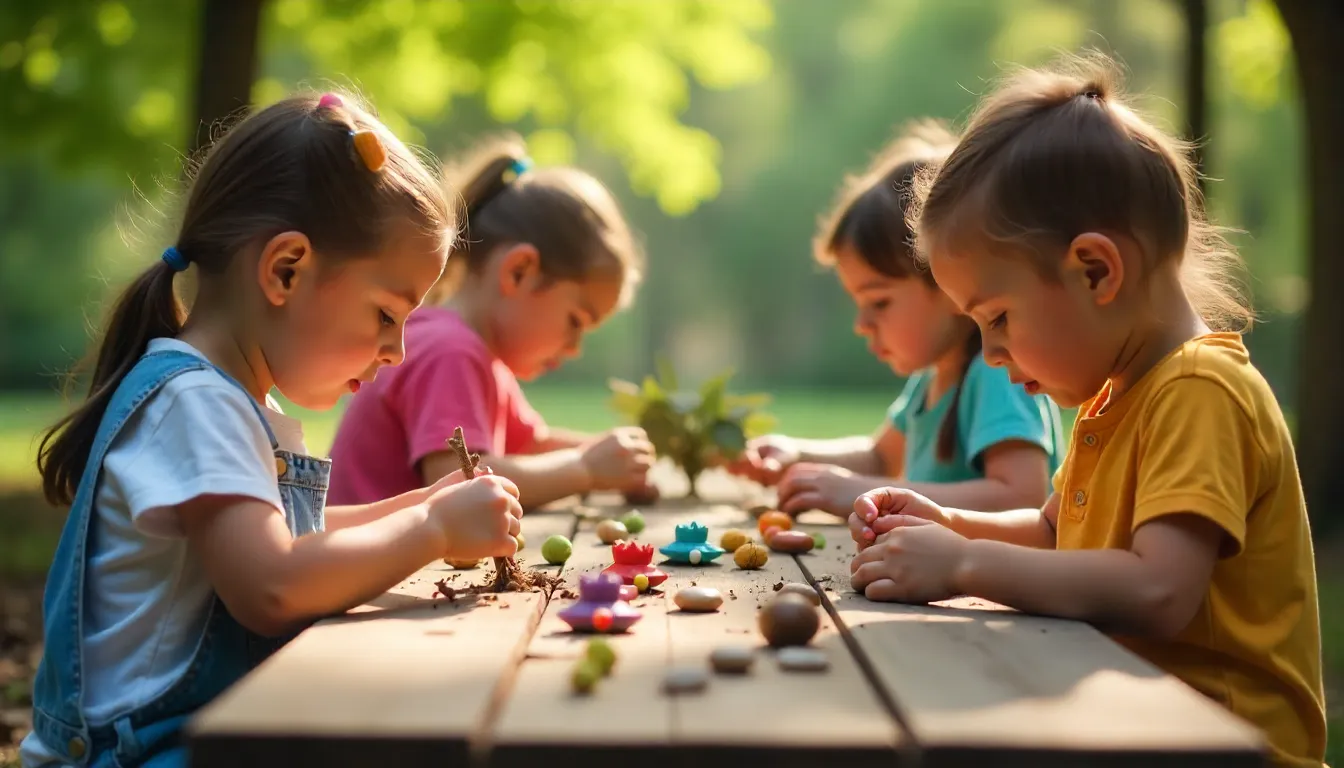
Collect outdoor items like leaves, twigs, seeds, and stones to create nature collages or assemblages. This connects art creation to scientific observation, encouraging children to notice details in natural objects.
Children practice classification skills as they sort materials by color, size, texture, or type. They develop descriptive vocabulary and learn to see common objects in new ways—building the observation skills essential for scientific inquiry. When making nature collages, you might begin with free templates from farm coloring page crafts and layer in leaves, twigs, and textures to build a dimensional landscape.
Bead Crafts for Pattern and Sequencing
String beads to create jewelry, keychains, or decorative items. Start with simple patterns—alternating two colors—then progress to more complex sequences. This hands-on pattern work builds mathematical thinking while creating finished products children feel proud to use or gift.
Letter beads add literacy connections, allowing children to spell names, sight words, or vocabulary terms while developing fine motor skills. The small size of beads demands precise pincer grip—the same hand position needed for effective pencil control.
You can repurpose free printables — see our article on craft ideas using cartoon coloring pages — to build 3D projects or mixed media collages using the same principles of art integration.
Integrating Art With Core Academic Content
The most powerful educational art projects explicitly connect creative work with academic learning objectives. These integration strategies transform art from enrichment activity to essential learning tool.
Literature Connection Projects
Create character portraits using torn magazine paper after reading a story. Children must consider character descriptions and their own interpretations, then find images representing their vision. This activity builds comprehension skills while teaching visual communication.
Design book covers for favorite novels, considering how images and text work together to communicate meaning. This graphic design thinking develops understanding of visual rhetoric and persuasive communication.
Mathematical Art Activities
Use fingerprints or dot painting to create visual representations of numbers—five dots for the numeral 5, three handprints to show three groups. This concrete representation helps young learners connect abstract numerals to quantity.
Create fraction circles using cut paper in different colors, visually demonstrating how parts combine to create wholes. Children physically manipulate the pieces, building conceptual understanding that purely abstract teaching often fails to achieve.
Science Integration Through Art
Draw detailed observations of natural objects, plants, or animals. Scientific illustration teaches careful observation and accurate representation—core skills for scientific inquiry. Children learn to notice details they initially overlooked, developing the attention to precision that science requires.
Create models of systems studied in science class—the water cycle, plant life cycles, or solar system representations. Three-dimensional modeling requires understanding relationships and processes, not just memorizing facts.
Social Studies Visual Projects
Design maps of neighborhoods, historical scenes, or geographic features using various art materials. Map-making builds spatial reasoning while requiring decisions about representation, scale, and symbols—fundamental geographic thinking.
Create cultural art projects exploring traditions from around the world. This develops cultural awareness while teaching that art serves different purposes in different societies—communication, celebration, religious expression, and historical record.

Adapting Projects for Different Skill Levels
Successful art integration requires matching project complexity to student developmental stages. These adaptation strategies ensure every child experiences appropriate challenge and success.
Supporting Struggling Learners
Provide templates or outlines for children who struggle with initial planning or drawing. The template offers structure while still allowing creative decisions about colors, patterns, and materials.
Break complex projects into smaller steps, completing one stage per session. This prevents overwhelm while building task completion skills. Children experience success at each stage rather than feeling discouraged by distant final goals.
Offer choice in materials and methods. Some children work better with paint while others prefer collage. Allowing material selection gives children agency while working toward the same learning objective.
Challenging Advanced Students
Invite advanced students to add complexity—multiple materials, more intricate designs, or additional constraints. Challenge them to solve specific design problems: create a portrait using only geometric shapes, or design something using exactly three colors.
Encourage these students to explain their creative process and choices. This metacognitive reflection develops the self-awareness and communication skills that separate competent students from exceptional ones.
Connect their work to professional fields—graphic design, architecture, scientific illustration, or industrial design. This real-world connection motivates deeper engagement while introducing potential career pathways.
Creating Supportive Art Learning Environments
The environment and approach matter as much as the specific projects. These principles create spaces where creative learning thrives.
Emphasizing Process Over Product
Focus attention on what children learn during creation rather than only praising finished products. Ask questions about their process: “How did you decide on these colors?” or “What was the trickiest part to figure out?”
This shifts evaluation from appearance to thinking, building growth mindset and encouraging experimentation. Children become more willing to take creative risks when they know process matters more than perfection.
Maintaining Appropriate Independence
Resist the urge to fix, improve, or complete children’s work. When adults take over, children lose learning opportunities and receive the message that their efforts aren’t good enough.
Offer guidance through questions rather than corrections: “What would happen if you added more glue there?” helps children problem-solve rather than simply following adult direction.
Stocking Essential Supplies Efficiently
Build a basic supply collection focusing on versatile, affordable materials: construction paper in various colors, white glue, washable paints, crayons and markers, safety scissors, and tape. These basics support hundreds of different projects.
Supplement with recycled materials—cardboard boxes, bottle caps, fabric scraps, newspapers, and magazines. This teaches resourcefulness while expanding creative possibilities at minimal cost.
Building Regular Creative Time
Schedule consistent art time rather than treating it as occasional enrichment. Regular creative work builds skills cumulatively—children develop techniques, confidence, and creative thinking through repeated practice.
Even brief sessions—fifteen to twenty minutes several times weekly—provide meaningful development. Consistency matters more than duration, establishing creative thinking as a regular part of learning.
Addressing Common Challenges and Concerns
Teachers and parents often hesitate to increase art activities due to practical concerns. These strategies address the most common obstacles.
Managing Time Constraints
Choose projects that align with current academic content, addressing multiple objectives simultaneously. A symmetry painting teaches mathematical concepts while building fine motor skills—efficient use of limited time.
Prepare materials in advance, organizing supplies so setup takes minutes rather than draining instructional time. Simple systems—materials in labeled bins, paper pre-cut to size—remove barriers to regular art integration.
Handling Mess and Cleanup
Select materials strategically based on available cleanup capacity. Some days allow for painting while others work better with dry materials like paper and crayons.
Teach cleanup as part of the learning process. Even young children can wipe tables, rinse brushes, and return materials to proper locations. Building responsibility for workspace maintenance develops executive function and community citizenship.
Supporting Reluctant Artists
Some children resist creative activities, feeling anxious about not knowing exactly what to do or worried about making mistakes. For these learners, provide structured choices rather than complete freedom.
Offer several examples or starting points: “You could make an underwater scene, a jungle, or design your own setting.” This removes the paralysis of unlimited options while preserving creative decision-making.
Long-Term Benefits of Regular Art Integration
The skills children develop through consistent creative activity extend far beyond elementary school. These foundational abilities support success throughout their educational journey and into adult life.
Building Creative Confidence
Regular positive experiences with art creation teach children they can generate original ideas and bring them to reality. This creative confidence transfers to all areas where innovation matters—scientific hypothesis, essay writing, mathematical problem-solving, and life planning.
Developing Visual Literacy
Our world communicates increasingly through images, infographics, and visual media. Children who understand how images convey meaning, persuade audiences, and represent information possess literacy as essential as reading text.
Fostering Intrinsic Motivation
Art activities that allow genuine choice and expression build intrinsic motivation—the drive to engage because the activity itself is rewarding rather than for external rewards. This internal motivation predicts long-term academic success and life satisfaction.
Making Art Education Accessible and Inclusive
Every child deserves opportunities for creative expression and skill development through art. These principles ensure equitable access regardless of circumstance.
Accommodating Different Abilities
Adapt tools and materials for children with physical limitations. Larger brushes or grips, adapted scissors, or alternative application methods ensure participation without frustration.
Provide sensory-friendly options for children sensitive to textures. Some children avoid finger paint but happily use brushes or sponges. Offering material choices accommodates different sensory profiles while working toward the same goals.
Respecting Cultural Perspectives
Recognize that different cultures value different aspects of art and creativity. Some emphasize representation and technical skill while others prioritize expression and innovation. Honor diverse artistic traditions through project selection and discussion.
Addressing Resource Limitations
Many families and schools lack funds for art supplies. Focus on free or extremely low-cost materials—paper, natural objects, recycled materials, and homemade compounds like salt dough or flour paste.
Organize supply sharing programs where families contribute different items, pooling resources to ensure all children access necessary materials. Community partnerships with businesses often yield donations of surplus materials.
Taking Action: Implementing Regular Art Integration
Start small rather than attempting comprehensive changes immediately. Choose one or two projects that align with your current teaching or family routines. Build from these initial successes, gradually increasing frequency and variety.
Connect with other educators or parents implementing art integration. Sharing ideas, materials, and experiences makes the process more manageable and enjoyable. Online communities, local parent groups, or teacher collaboration time provide support and inspiration.
Document children’s growth through photos and work samples. This evidence demonstrates progress to skeptical administrators or family members while helping you identify which activities generate the strongest learning and engagement.
Creative expression isn’t a luxury in elementary education—it’s a necessity for complete child development. Every time a child picks up a paintbrush, cuts paper into shapes, or molds clay into form, they’re building the cognitive, physical, and emotional foundations for academic success and lifelong learning. The investment in art materials and instructional time returns dividends across every aspect of children’s development and achievement. For ongoing inspiration and new project ideas, check the blog of creative coloring-craft ideas regularly—it’s full of fresh themes and ways to connect coloring with learning.